How to read: the red numbers point at a part of the page. The green note with the same number explains it in plain words. The tiny grey line gives the state source.
Format simplified, based on public sample.
Mock NJ CAT: Sam Example (filled-in example)
Format simplified, based on public sample. Follows the section headings of the NJ CAT public sample (Version 1.3, April 27, 2015). Not the state's real form. No logo or seal. Not every question is shown.
The NJ CAT is a list of questions about what a person can do and what help they need. 'Look-back' means how far back a question asks about.
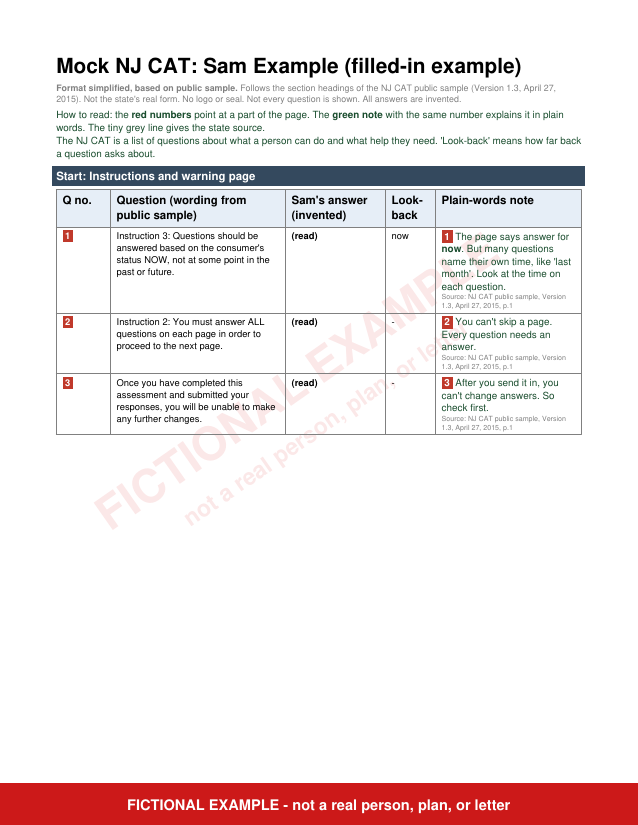
Start: Instructions and warning page
Q no.
Question (wording from public sample)
Sam's answer
Look-back
Plain-words note
[1]
Instruction 3: Questions should be answered based on the consumer's status NOW, not at some point in the past or future.
(read)
now
[1] The page says answer for now. But many questions name their own time, like 'last month'. Look at the time on each question. Source: NJ CAT public sample, Version 1.3, April 27, 2015, p.1
[2]
Instruction 2: You must answer ALL questions on each page in order to proceed to the next page.
(read)
-
[2] You can't skip a page. Every question needs an answer. Source: NJ CAT public sample, Version 1.3, April 27, 2015, p.1
[3]
Once you have completed this assessment and submitted your responses, you will be unable to make any further changes.
(read)
-
[3] After you send it in, you can't change answers. So check first. Source: NJ CAT public sample, Version 1.3, April 27, 2015, p.1
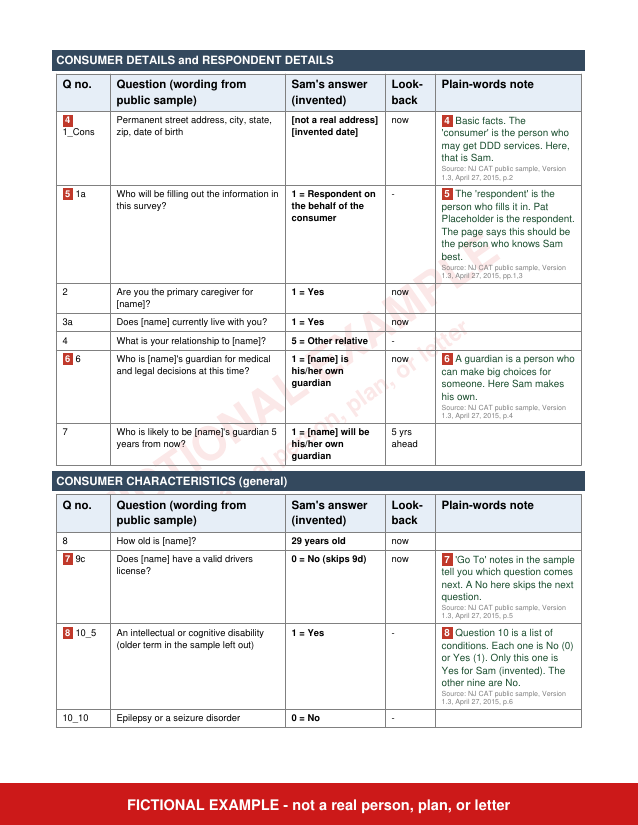
CONSUMER DETAILS and RESPONDENT DETAILS
Q no.
Question (wording from public sample)
Sam's answer
Look-back
Plain-words note
[4] 1_Cons
Permanent street address, city, state, zip, date of birth
[address] [date]
now
[4] Basic facts. The 'consumer' is the person who may get DDD services. Here, that is Sam. Source: NJ CAT public sample, Version 1.3, April 27, 2015, p.2
[5] 1a
Who will be filling out the information in this survey?
1 = Respondent on the behalf of the consumer
-
[5] The 'respondent' is the person who fills it in. Pat Placeholder is the respondent. The page says this should be the person who knows Sam best. Source: NJ CAT public sample, Version 1.3, April 27, 2015, pp.1,3
2
Are you the primary caregiver for [name]?
1 = Yes
now
3a
Does [name] currently live with you?
1 = Yes
now
4
What is your relationship to [name]?
5 = Other relative
-
[6] 6
Who is [name]'s guardian for medical and legal decisions at this time?
1 = [name] is his/her own guardian
now
[6] A guardian is a person who can make big choices for someone. Here Sam makes his own. Source: NJ CAT public sample, Version 1.3, April 27, 2015, p.4
7
Who is likely to be [name]'s guardian 5 years from now?
1 = [name] will be his/her own guardian
5 yrs ahead
CONSUMER CHARACTERISTICS (general)
Q no.
Question (wording from public sample)
Sam's answer
Look-back
Plain-words note
8
How old is [name]?
29 years old
now
[7] 9c
Does [name] have a valid drivers license?
0 = No (skips 9d)
now
[7] 'Go To' notes in the sample tell you which question comes next. A No here skips the next question. Source: NJ CAT public sample, Version 1.3, April 27, 2015, p.5
[8] 10_5
An intellectual or cognitive disability (older term in the sample left out)
1 = Yes
-
[8] Question 10 is a list of conditions. Each one is No (0) or Yes (1). Only this one is Yes for Sam. The other nine are No. Source: NJ CAT public sample, Version 1.3, April 27, 2015, p.6
10_10
Epilepsy or a seizure disorder
0 = No
-
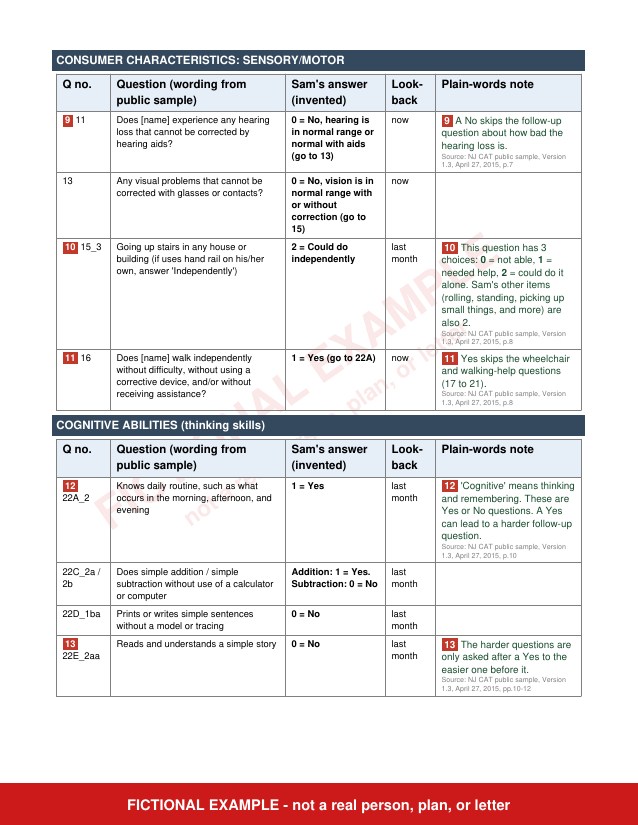
CONSUMER CHARACTERISTICS: SENSORY/MOTOR
Q no.
Question (wording from public sample)
Sam's answer
Look-back
Plain-words note
[9] 11
Does [name] experience any hearing loss that cannot be corrected by hearing aids?
0 = No, hearing is in normal range or normal with aids (go to 13)
now
[9] A No skips the follow-up question about how bad the hearing loss is. Source: NJ CAT public sample, Version 1.3, April 27, 2015, p.7
13
Any visual problems that cannot be corrected with glasses or contacts?
0 = No, vision is in normal range with or without correction (go to 15)
now
[10] 15_3
Going up stairs in any house or building (if uses hand rail on his/her own, answer 'Independently')
2 = Could do independently
last month
[10] This question has 3 choices: 0 = not able, 1 = needed help, 2 = could do it alone. Sam's other items (rolling, standing, picking up small things, and more) are also 2. Source: NJ CAT public sample, Version 1.3, April 27, 2015, p.8
[11] 16
Does [name] walk independently without difficulty, without using a corrective device, and/or without receiving assistance?
1 = Yes (go to 22A)
now
[11] Yes skips the wheelchair and walking-help questions (17 to 21). Source: NJ CAT public sample, Version 1.3, April 27, 2015, p.8
COGNITIVE ABILITIES (thinking skills)
Q no.
Question (wording from public sample)
Sam's answer
Look-back
Plain-words note
[12] 22A_2
Knows daily routine, such as what occurs in the morning, afternoon, and evening
1 = Yes
last month
[12] 'Cognitive' means thinking and remembering. These are Yes or No questions. A Yes can lead to a harder follow-up question. Source: NJ CAT public sample, Version 1.3, April 27, 2015, p.10
22C_2a / 2b
Does simple addition / simple subtraction without use of a calculator or computer
Addition: 1 = Yes. Subtraction: 0 = No
last month
22D_1ba
Prints or writes simple sentences without a model or tracing
0 = No
last month
[13] 22E_2aa
Reads and understands a simple story
0 = No
last month
[13] The harder questions are only asked after a Yes to the easier one before it. Source: NJ CAT public sample, Version 1.3, April 27, 2015, pp.10-12
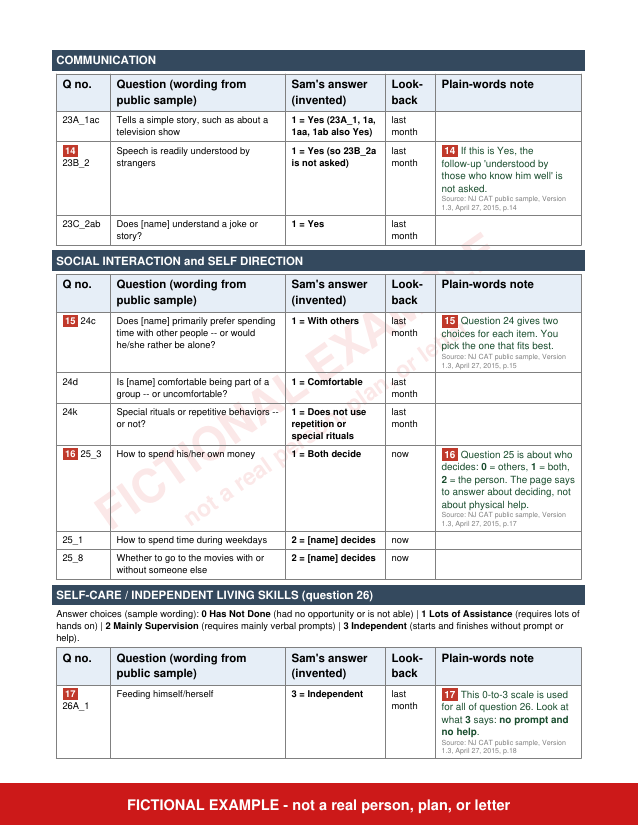
COMMUNICATION
Q no.
Question (wording from public sample)
Sam's answer
Look-back
Plain-words note
23A_1ac
Tells a simple story, such as about a television show
1 = Yes (23A_1, 1a, 1aa, 1ab also Yes)
last month
[14] 23B_2
Speech is readily understood by strangers
1 = Yes (so 23B_2a is not asked)
last month
[14] If this is Yes, the follow-up 'understood by those who know him well' is not asked. Source: NJ CAT public sample, Version 1.3, April 27, 2015, p.14
23C_2ab
Does [name] understand a joke or story?
1 = Yes
last month
SOCIAL INTERACTION and SELF DIRECTION
Q no.
Question (wording from public sample)
Sam's answer
Look-back
Plain-words note
[15] 24c
Does [name] primarily prefer spending time with other people -- or would he/she rather be alone?
1 = With others
last month
[15] Question 24 gives two choices for each item. You pick the one that fits best. Source: NJ CAT public sample, Version 1.3, April 27, 2015, p.15
24d
Is [name] comfortable being part of a group -- or uncomfortable?
1 = Comfortable
last month
24k
Special rituals or repetitive behaviors -- or not?
1 = Does not use repetition or special rituals
last month
[16] 25_3
How to spend his/her own money
1 = Both decide
now
[16] Question 25 is about who decides: 0 = others, 1 = both, 2 = the person. The page says to answer about deciding, not about physical help. Source: NJ CAT public sample, Version 1.3, April 27, 2015, p.17
25_1
How to spend time during weekdays
2 = [name] decides
now
25_8
Whether to go to the movies with or without someone else
2 = [name] decides
now
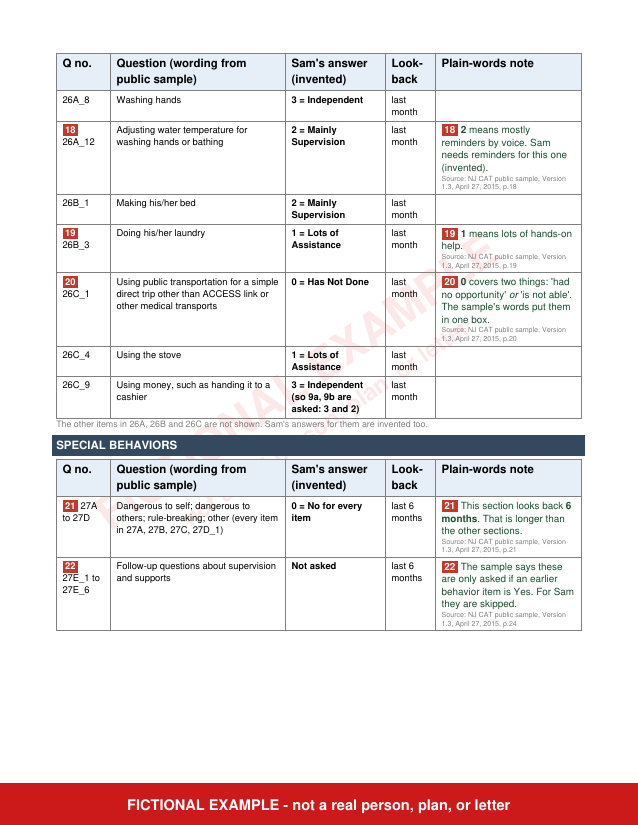
SELF-CARE / INDEPENDENT LIVING SKILLS (question 26)
Answer choices (sample wording): 0 Has Not Done (had no opportunity or is not able) | 1 Lots of Assistance (requires lots of hands on) | 2 Mainly Supervision (requires mainly verbal prompts) | 3 Independent (starts and finishes without prompt or help).
Q no.
Question (wording from public sample)
Sam's answer
Look-back
Plain-words note
[17] 26A_1
Feeding himself/herself
3 = Independent
last month
[17] This 0-to-3 scale is used for all of question 26. Look at what 3 says: no prompt and no help. Source: NJ CAT public sample, Version 1.3, April 27, 2015, p.18
26A_8
Washing hands
3 = Independent
last month
[18] 26A_12
Adjusting water temperature for washing hands or bathing
2 = Mainly Supervision
last month
[18]2 means mostly reminders by voice. Sam needs reminders for this one. Source: NJ CAT public sample, Version 1.3, April 27, 2015, p.18
26B_1
Making his/her bed
2 = Mainly Supervision
last month
[19] 26B_3
Doing his/her laundry
1 = Lots of Assistance
last month
[19]1 means lots of hands-on help. Source: NJ CAT public sample, Version 1.3, April 27, 2015, p.19
[20] 26C_1
Using public transportation for a simple direct trip other than ACCESS link or other medical transports
0 = Has Not Done
last month
[20]0 covers two things: 'had no opportunity' or 'is not able'. The sample's words put them in one box. Source: NJ CAT public sample, Version 1.3, April 27, 2015, p.20
26C_4
Using the stove
1 = Lots of Assistance
last month
26C_9
Using money, such as handing it to a cashier
3 = Independent (so 9a, 9b are asked: 3 and 2)
last month
The other items in 26A, 26B and 26C are not shown.
SPECIAL BEHAVIORS
Q no.
Question (wording from public sample)
Sam's answer
Look-back
Plain-words note
[21] 27A to 27D
Dangerous to self; dangerous to others; rule-breaking; other (every item in 27A, 27B, 27C, 27D_1)
0 = No for every item
last 6 months
[21] This section looks back 6 months. That is longer than the other sections. Source: NJ CAT public sample, Version 1.3, April 27, 2015, p.21
[22] 27E_1 to 27E_6
Follow-up questions about supervision and supports
Not asked
last 6 months
[22] The sample says these are only asked if an earlier behavior item is Yes. For Sam they are skipped. Source: NJ CAT public sample, Version 1.3, April 27, 2015, p.24
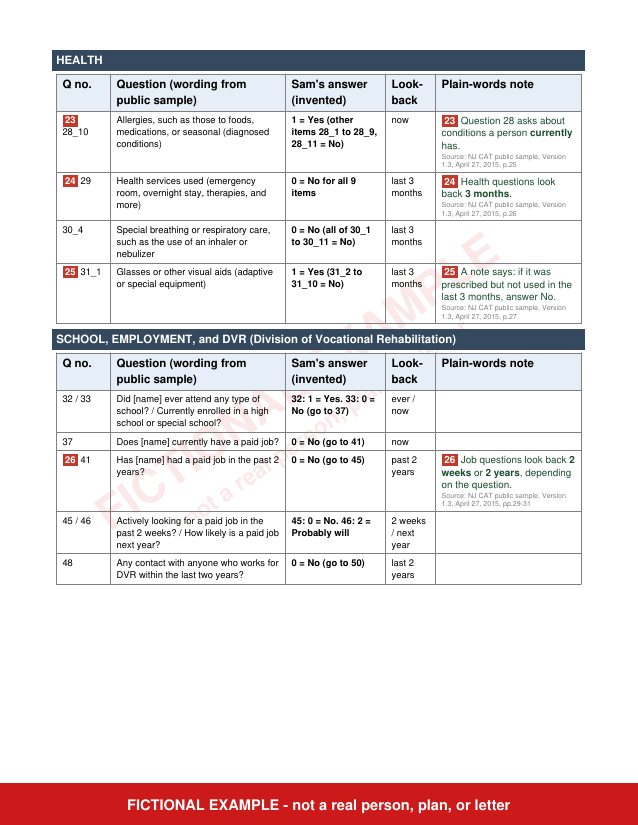
HEALTH
Q no.
Question (wording from public sample)
Sam's answer
Look-back
Plain-words note
[23] 28_10
Allergies, such as those to foods, medications, or seasonal (diagnosed conditions)
1 = Yes (other items 28_1 to 28_9, 28_11 = No)
now
[23] Question 28 asks about conditions a person currently has. Source: NJ CAT public sample, Version 1.3, April 27, 2015, p.25
[24] 29
Health services used (emergency room, overnight stay, therapies, and more)
0 = No for all 9 items
last 3 months
[24] Health questions look back 3 months. Source: NJ CAT public sample, Version 1.3, April 27, 2015, p.26
30_4
Special breathing or respiratory care, such as the use of an inhaler or nebulizer
0 = No (all of 30_1 to 30_11 = No)
last 3 months
[25] 31_1
Glasses or other visual aids (adaptive or special equipment)
1 = Yes (31_2 to 31_10 = No)
last 3 months
[25] A note says: if it was prescribed but not used in the last 3 months, answer No. Source: NJ CAT public sample, Version 1.3, April 27, 2015, p.27
SCHOOL, EMPLOYMENT, and DVR (Division of Vocational Rehabilitation)
Q no.
Question (wording from public sample)
Sam's answer
Look-back
Plain-words note
32 / 33
Did [name] ever attend any type of school? / Currently enrolled in a high school or special school?
32: 1 = Yes. 33: 0 = No (go to 37)
ever / now
37
Does [name] currently have a paid job?
0 = No (go to 41)
now
[26] 41
Has [name] had a paid job in the past 2 years?
0 = No (go to 45)
past 2 years
[26] Job questions look back 2 weeks or 2 years, depending on the question. Source: NJ CAT public sample, Version 1.3, April 27, 2015, pp.29-31
45 / 46
Actively looking for a paid job in the past 2 weeks? / How likely is a paid job next year?
45: 0 = No. 46: 2 = Probably will
2 weeks / next year
48
Any contact with anyone who works for DVR within the last two years?
0 = No (go to 50)
last 2 years
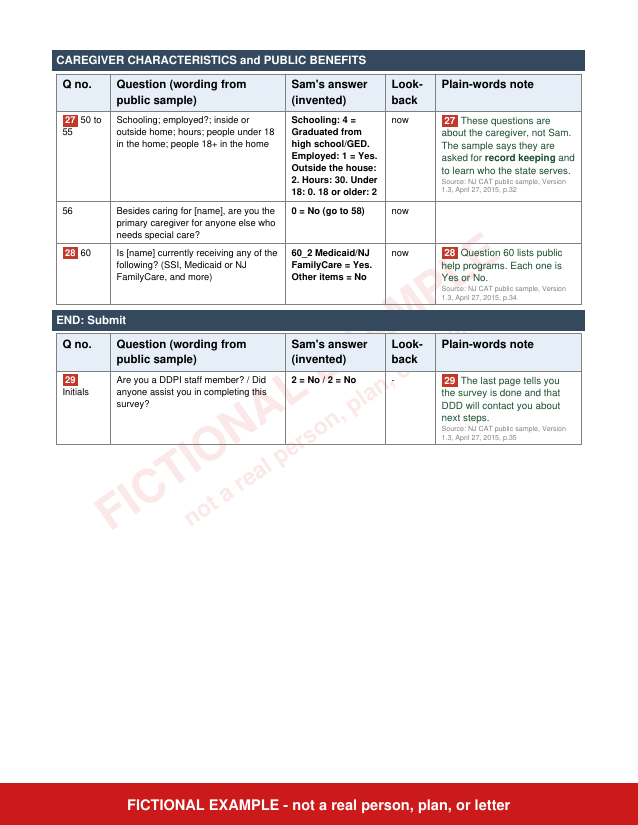
CAREGIVER CHARACTERISTICS and PUBLIC BENEFITS
Q no.
Question (wording from public sample)
Sam's answer
Look-back
Plain-words note
[27] 50 to 55
Schooling; employed?; inside or outside home; hours; people under 18 in the home; people 18+ in the home
Schooling: 4 = Graduated from high school/GED. Employed: 1 = Yes. Outside the house: 2. Hours: 30. Under 18: 0. 18 or older: 2
now
[27] These questions are about the caregiver, not Sam. The sample says they are asked for record keeping and to learn who the state serves. Source: NJ CAT public sample, Version 1.3, April 27, 2015, p.32
56
Besides caring for [name], are you the primary caregiver for anyone else who needs special care?
0 = No (go to 58)
now
[28] 60
Is [name] currently receiving any of the following? (SSI, Medicaid or NJ FamilyCare, and more)
60_2 Medicaid/NJ FamilyCare = Yes. Other items = No
now
[28] Question 60 lists public help programs. Each one is Yes or No. Source: NJ CAT public sample, Version 1.3, April 27, 2015, p.34
END: Submit
Q no.
Question (wording from public sample)
Sam's answer
Look-back
Plain-words note
[29] Initials
Are you a DDPI staff member? / Did anyone assist you in completing this survey?
2 = No / 2 = No
-
[29] The last page tells you the survey is done and that DDD will contact you about next steps. Source: NJ CAT public sample, Version 1.3, April 27, 2015, p.35
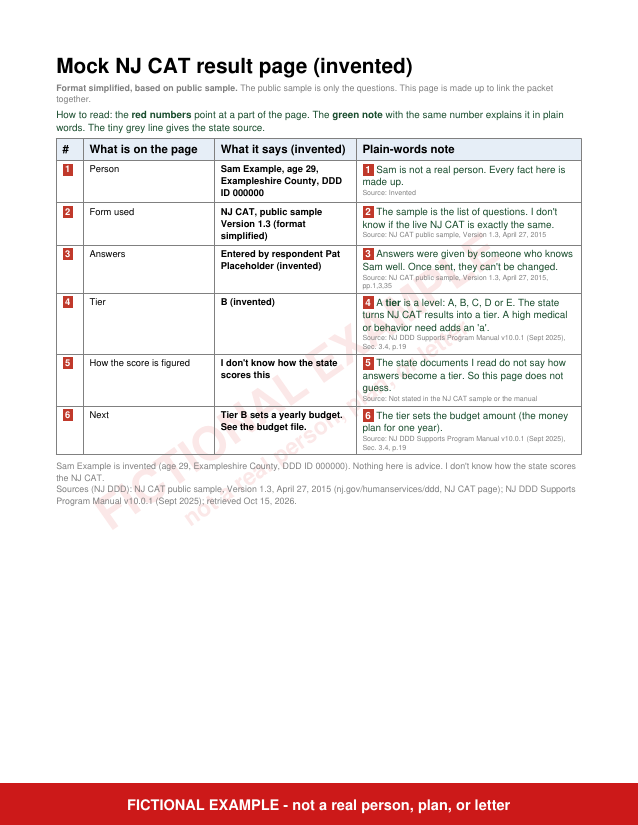
Mock NJ CAT result page
Format simplified, based on public sample. The public sample is only the questions. This page links the packet together.
How to read: the red numbers point at a part of the page. The green note with the same number explains it in plain words. The tiny grey line gives the state source.
#
What is on the page
What it says
Plain-words note
[1]
Form used
NJ CAT, public sample Version 1.3 (format simplified)
[1] The sample is the list of questions. Source: NJ CAT public sample, Version 1.3, April 27, 2015
[2]
Answers
Entered by respondent Pat Placeholder
[2] Answers were given by someone who knows Sam well. Once sent, they can't be changed. Source: NJ CAT public sample, Version 1.3, April 27, 2015, pp.1,3,35
[3]
Tier
B
[3] A tier is a level: A, B, C, D or E. The state turns NJ CAT results into a tier. A high medical or behavior need adds an 'a'. Source: NJ DDD Supports Program Manual v10.0.1 (Sept 2025), Sec. 3.4, p.19
[4]
Next
Tier B sets a yearly budget. See the budget file.
[4] The tier sets the budget amount (the money plan for one year). Source: NJ DDD Supports Program Manual v10.0.1 (Sept 2025), Sec. 3.4, p.19
Sam Example: age 29, Exampleshire County, DDD ID 000000. Nothing here is advice.
Sources
Sources (NJ DDD): NJ CAT public sample, Version 1.3, April 27, 2015 (nj.gov/humanservices/ddd, NJ CAT page); NJ DDD Supports Program Manual v10.0.1 (Sept 2025); retrieved Oct 15, 2026.